



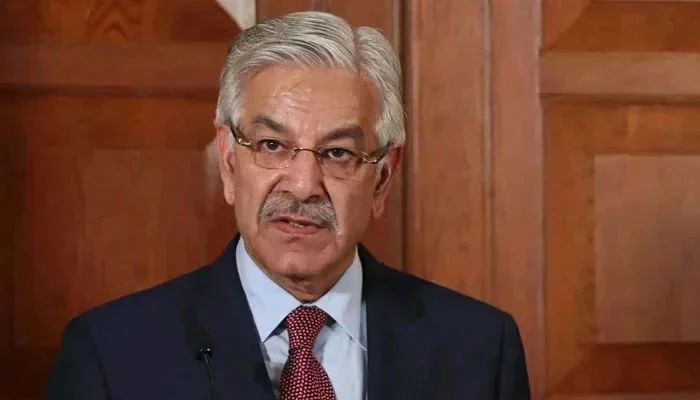
SIALKOT: Defence Minister Khawaja Asif has criticised political victimisation, saying civilian governments often arrest people before deciding what charges to bring against them.
“Civilian governments, when they want to arrest someone, first arrest them and then think about what charge to bring,” he told reporters in Sialkot on Saturday.
His remarks come amid ongoing tensions between the ruling Pakistan Muslim League-Nawaz (PML-N) and the opposition Pakistan Tehreek-e-Insaf (PTI). The PTI has repeatedly accused the federal government of political victimisation, pointing to the imprisonment of its founder, Imran Khan, and several party leaders.
The opposition has also criticised the imposition of emergency and governor’s rule in Khyber Pakhtunkhwa on October 11, which rendered the PTI-led provincial government non-functional.
Chief Minister Sohail Afridi and several members of his cabinet were subsequently taken into preventive custody following the federal government’s move.
The PTI condemned the detentions as politically motivated. However, the federal government maintained that the measures were necessary to address the province’s deteriorating security situation and combat terrorism.
Asif Recalls His Imprisonment
Recalling his own political struggles, Asif said he had been imprisoned four times, including at Attock Fort during former military ruler Pervez Musharraf’s tenure.
He also recalled spending six months in National Accountability Bureau (NAB) custody during the PTI government in 2020. According to the minister, those responsible for his detention could not clearly explain the charges against him.
Asif said he repeatedly asked NAB officials what allegations they had levelled against him. He added that political victimisation was never in the country’s interest.
The defence minister said he entered politics in 1991 and had spent decades serving the country, witnessing numerous political ups and downs along the way.
He acknowledged that he sometimes felt tired but said he remained committed to serving Sialkot. He described the city as his identity and said the welfare of its people was his responsibility.
Exchange With Fazlur Rehman
Asif also referred to his recent exchange with Jamiat Ulema-e-Islam-Fazl (JUI-F) chief Maulana Fazlur Rehman.
He said he had urged Fazlur Rehman during a National Assembly session to reconsider his political narrative.
The defence minister added that he met the JUI-F chief in the assembly two days earlier. He said the meeting left him with the impression that Fazlur Rehman still had the energy to remain active in politics.
Pakistan’s Diplomatic Role
Turning to foreign affairs, Asif said Pakistan was playing a historic role in efforts to resolve the Iran-US conflict and ease tensions between Iran and its Arab neighbours.
He said diplomatic efforts under the leadership of Chief of Defence Forces and Chief of Army Staff Field Marshal Syed Asim Munir were continuing. He added that Pakistan had earned an international standing of which its people could be proud.
Asif said he had represented Pakistan at defence agreements signed in Makkah and Doha.
He also argued that overseas military bases did not necessarily guarantee the security of host countries. According to the minister, such facilities often served the interests of the powers operating them and were intended to protect Israel.
The defence minister further claimed that Pakistan had defeated an enemy five times its size during the latest conflict with India.
He said previous wars had left some uncertainty over their outcomes. However, he argued that the latest conflict was different because India and its military had acknowledged the result.
Asif also praised the armed forces for their prolonged campaign against terrorism, saying personnel had continued to sacrifice their lives in defence of the country.
Youth and Education
The defence minister described young people as one of Pakistan’s most valuable assets, saying educated and skilled youth could contribute significantly to national development.
He acknowledged changes in the education sector over the years but said politicians were generally reluctant to take charge of the education ministry.
According to Asif, many politicians viewed the portfolio as offering limited political benefits, despite the importance of education to the country’s future.