



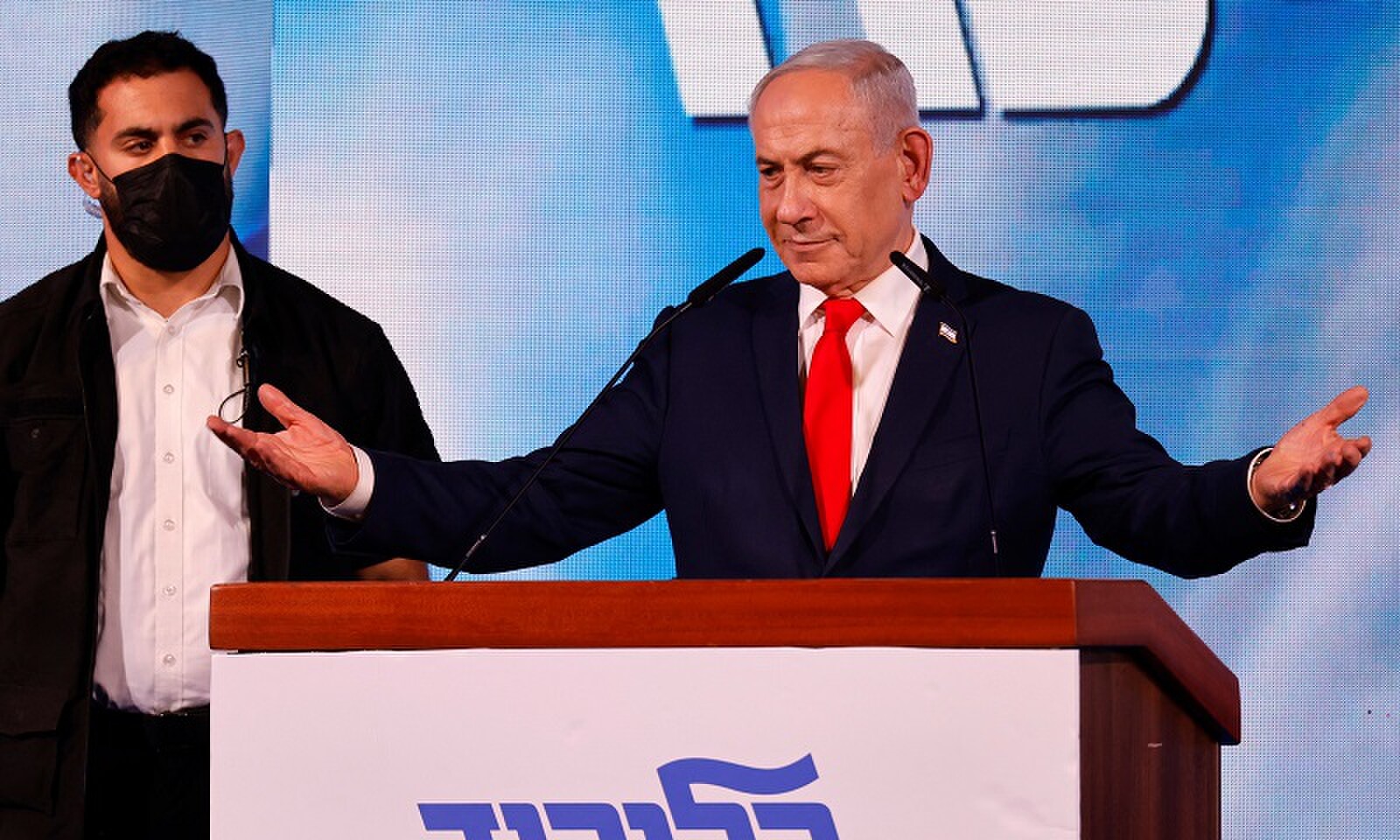
JERUSALEM: Israeli Prime Minister Benjamin Netanyahu’s bloc was leading its opposition rivals on Wednesday but remained short of a parliamentary majority, with two-thirds of votes counted in the country’s pivotal general election.
Voters turned out in the highest numbers in decades to decide Netanyahu’s political future. The longest-serving prime minister in Israel’s history has moved the country sharply to the right and launched multiple military campaigns following Hamas’s October 7, 2023 attack.
Following the vote, both Netanyahu and his main rival, Gadi Eisenkot, vowed to form a government despite neither camp securing a projected majority.
With 66% of ballots counted, Netanyahu’s bloc had secured 54 of the Knesset’s 120 seats. Eisenkot’s opposition bloc held 48 seats, while non-aligned Arab parties had 18.
The partial results could change as election officials count the remaining ballots.
Coalition Talks Could Determine Israel’s Next Government
Exit polls had placed Eisenkot’s opposition bloc and Netanyahu’s right-wing camp almost neck and neck, with each projected to win around 51 seats. Neither side was close to the 61 seats required for a parliamentary majority.
Arab Israeli parties recorded some of the strongest gains, benefiting from a significant increase in turnout among their voters.
The partial results suggest Eisenkot’s bloc could potentially secure a majority by forming a coalition with Arab parties. However, several members of his camp had expressed reluctance to pursue such an arrangement during the election campaign.
Yair Golan, leader of Israel’s main left-wing party and a member of Eisenkot’s camp, called for cooperation with Arab lawmakers on Wednesday.
“We must no longer accept Netanyahu’s racist division between Jewish votes and Arab votes,” Golan said in a post on X.
“We have a responsibility. And we have an opportunity to form a government of change in partnership with Israel’s Arab citizens.”
During the campaign, Eisenkot had said he would not govern with Israeli Arab lawmakers. Netanyahu had also questioned the legitimacy of a government that relied on Arab parliamentary support.
Alternatively, Arab lawmakers could support Eisenkot on individual parliamentary votes without formally joining a coalition. This arrangement could allow him to lead a minority government.
However, the absence of a clear majority could trigger weeks of coalition negotiations. If the talks fail, Israel could face another election.
A political stalemate could benefit Netanyahu in the short term, as he would remain caretaker prime minister until a new government takes office.
Final results were expected by Thursday evening or Friday morning.
Netanyahu Calls for a Strong Right-Wing Government
Netanyahu addressed cheering supporters at a Jerusalem convention centre shortly after 3am on Wednesday.
The 77-year-old prime minister called for a “strong government of the right” and urged the “Jewish and Zionist majority” to unite.
However, he delivered a brief speech and did not directly claim victory.
US President Donald Trump said on Wednesday that his endorsement had helped Netanyahu “a lot”.
Netanyahu has governed Israel on and off for nearly two decades, making him the country’s longest-serving prime minister.
Eisenkot Says Israeli Voters Want Change
Speaking to supporters in Tel Aviv, 66-year-old Eisenkot warned Netanyahu against using security concerns for political purposes.
“Netanyahu, don’t you dare use Israel’s security for your political needs,” Eisenkot said.
He described Netanyahu as “a caretaker prime minister, without a mandate or the people’s trust”.
Eisenkot also called for a swift effort to form a new government, saying another election would be a mistake.
“The public has voted for change,” he said. “A worthy leader would accept the people’s vote of no confidence and announce his retirement from political life today.”
Turnout reached nearly 78%, the highest level since 1999.
Israel Faces Growing International Isolation
The election took place as Israel faced mounting international criticism over its military campaigns in Iran and Gaza, expanding settlements, and violence against Palestinians in the occupied West Bank.
Eisenkot shares several of Netanyahu’s security positions and has supported Israel’s offensive in Gaza, which has devastated much of the territory.
However, he has promised to create a more inclusive political environment within Israel, improve the country’s international standing, and curb violence by settlers in the West Bank.
Meanwhile, exit polls projected that Israeli Arab parties would win 18 or 19 seats, marking a significant increase in their parliamentary representation.
Arab Israelis, also known as Palestinian citizens of Israel, account for approximately 21% of the country’s population.
The final distribution of seats and the outcome of subsequent coalition negotiations will determine who leads Israel’s next government.