



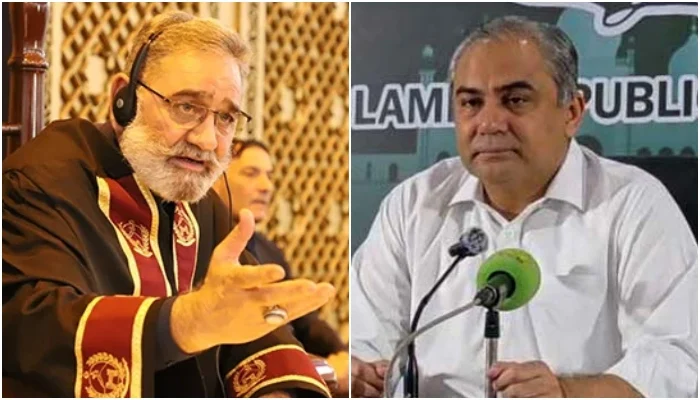
KP Assembly Speaker Hits Back at Naqvi Over Lawmakers’ Arrest Rules
PESHAWAR: Khyber Pakhtunkhwa Assembly Speaker Babar Saleem Swati has responded to Interior Minister Mohsin Naqvi’s criticism of a provincial law requiring the speaker’s permission before an MPA can be arrested or detained.
The dispute follows a September 25 letter from the KP Assembly Secretariat to the provincial police chief, reminding authorities to follow Section 11 of the KP Provincial Assembly (Powers, Immunities and Privileges) Act, 2026.
The provision requires the relevant magistrate or executive authority to seek the speaker’s prior permission, while providing reasons, before arresting an MPA on a criminal charge or detaining the lawmaker under an executive order.
Naqvi criticised the provision on Saturday, asking whether police would have to wait for the speaker’s approval if an MPA were accused of murder. He described it as an “extraordinary version” of equality before the law.
Swati Defends Parliamentary Privileges
Responding to Naqvi, Swati said parliamentary privileges were intended to protect the independence of the legislature and prevent elected representatives from facing political pressure.
“If the interior minister had been an elected public representative and part of the parliamentary system, he would know that parliamentary privileges enjoyed by assembly members are not a new invention,” Swati said.
He maintained that the provision did not place lawmakers above the law.
“Every member will face investigation, proceedings and judicial action,” the speaker said.
According to Swati, the speaker’s role is limited to ensuring that an arrest is not used for political revenge or to obstruct assembly proceedings.
He also argued that the requirement for the speaker’s permission was not a new practice in KP.
Speaker Questions Political Pressure
Swati questioned whether laws passed in circumstances involving alleged pressure on parliamentarians could be considered democratic.
“If you pass a law about immunity in the dark of the night, will that be law?” he asked.
He also questioned whether legislation passed by consensus between government and opposition members could be rejected as invalid.
“If the government and opposition parties in the Khyber Pakhtunkhwa Assembly pass a law by consensus, is that not a law?” Swati said.
The speaker further raised concerns about alleged raids by masked individuals on the homes of elected representatives and political leaders without warrants.
He urged Naqvi to reconsider the comparison he had made over the lawmakers’ privileges.
Earlier Changes to Privileges Law
The provision has been controversial since the KP Assembly passed the Provincial Assembly (Powers, Immunities and Privileges) Act, 2026.
The original legislation included provisions related to official passports, arms licences, preventive detention and the speaker’s permission before the arrest of members on criminal charges. Some provisions were later withdrawn following criticism.
The latest dispute emerged alongside the KP government’s revised Police Act 2026, which was approved by the provincial cabinet but had not yet been passed by the assembly at the time of the latest reports. The proposed police legislation has also drawn criticism from the federal government over changes to the police command structure.
Swati also referred to an international honour he recently received for his legislative work. He said representatives from 56 countries, 186 assemblies and around 80,000 parliamentarians attended the related conference.
The speaker alleged that Naqvi had affected Pakistan’s representation by withholding his passport and preventing several lawmakers from attending the conference.
He further accused the interior minister of seeking to prolong the government’s tenure by violating human rights principles.
Naqvi has not publicly responded to Swati’s latest remarks at the time of publication.