



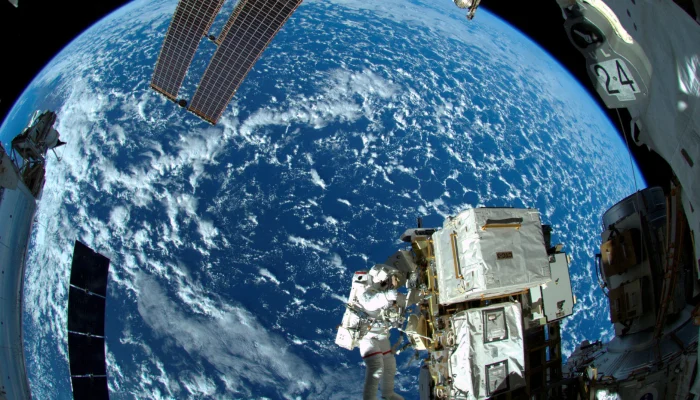
NAROWAL: Federal Minister Ahsan Iqbal on Saturday announced that Pakistan’s first astronaut would travel to space on November 25, marking a major milestone in the country’s space programme with China’s support.
Speaking at the closing ceremony of World Space Week in Narowal, Iqbal said China was cooperating with Pakistan to send its first astronaut into space.
“With China’s cooperation, Pakistan will reach new heights in the field of space research,” the minister said.
He added that Pakistan had set a target of landing on the Moon by 2035.
Iqbal also highlighted the growing importance of satellite technology. He said it had become critical for Pakistan and countries around the world.
He noted that Pakistan’s national security system also relied on satellite technology. Meanwhile, global space ambitions had expanded beyond lunar exploration to plans for human settlements on Mars.
“If we do not conduct research, we will fall behind in the race for development,” Iqbal warned.
The minister stressed the need to encourage young people to ask questions and develop the curiosity to find answers.
“Pakistan will have to regain the leadership in knowledge and research that was once our identity,” he said.
Iqbal also announced that the University of Narowal had secured first position at the Islamabad Science Festival.
He said construction of a centre for advanced technology and emerging sciences at the university would begin this year. According to the minister, the project had remained confined to official files during the previous government’s tenure.
He further announced that funds had been arranged to establish what he described as Pakistan’s first space museum at the University of Narowal.
Pakistan-China Space Cooperation
Pakistan’s planned human spaceflight forms part of its broader space cooperation with China.
According to Reuters, two Pakistani pilots, Zeeshan Ali and Khurram Daud, have undergone training at the China Astronaut Research and Training Center in Beijing.
The candidates were selected from around 20 finalists drawn from an initial pool of Pakistani pilots and scientists. Their training has included Chinese-language instruction, spacecraft systems and preparation for microgravity and the g-forces experienced during launch.
One of the two pilots is expected to become the first Pakistani astronaut to travel aboard China’s Tiangong space station. The person would also be the first foreign astronaut to visit the station.
The selected astronaut will serve as a “payload specialist” and conduct Pakistani scientific experiments during an approximately week-long stay in space.
Pakistan and China are also collaborating on a Pakistani-built lunar rover. The rover is expected to fly aboard China’s Chang’e 8 lunar mission around 2028.