



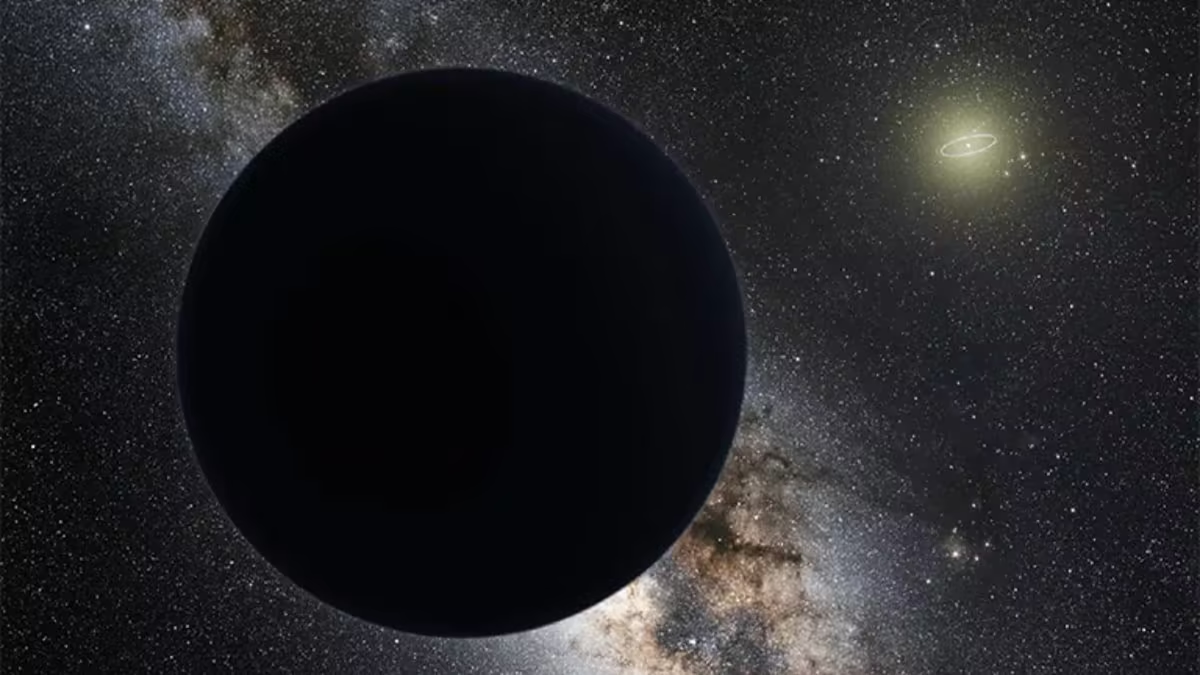
TAIPEI: Astronomers have identified a possible clue to the existence of the elusive Planet Nine after finding an infrared source that appears to have moved across the sky over 23 years.
Software initially identified 13 possible pairs of infrared sources. However, manual verification reduced the list to just one candidate.
The remaining source moved 47.5 arcminutes across the sky between two observations. That is about one and a half times the width of the full Moon.
The movement matches what researchers would expect from a Neptune-sized planet located far from the Sun.
Possible Evidence for Planet Nine
Terry Long Phan of National Tsing Hua University in Taiwan discovered the candidate during his PhD research. He worked with researchers from Taiwan, Japan and Australia.
Some scientists have proposed the existence of Planet Nine to explain the unusual arrangement and orbital tilts of certain trans-Neptunian objects.
Calculations suggest the hypothetical planet could orbit about 300 astronomical units (AU) from the Sun. This would place it at least 10 times farther away than Neptune.
Despite numerous sky surveys, however, Planet Nine has not been confirmed.
Why Planet Nine Is Difficult to Detect
Finding such a distant planet is challenging because sunlight must travel from the Sun to the planet and then back to Earth.
A Neptune-sized planet located 10 times farther from the Sun could therefore appear around 10,000 times fainter.
Its uncertain orbit creates another problem. Researchers do not know exactly where to point a telescope to find it.
However, the planet could emit heat that is detectable in infrared wavelengths.
In infrared light, Planet Nine could be about 100 times fainter than in visible light rather than 10,000 times fainter. This makes space-based infrared telescopes particularly useful for the search.
Infrared Surveys Reveal Candidate
Phan examined data from two infrared surveys, IRAS and AKARI.
IRAS was launched in 1983, while AKARI was launched in 2006. The missions therefore provided observations separated by 23 years.
At a distance of more than 300 AU, a planet would move so slowly that it could appear almost stationary in individual datasets.
However, it would shift slightly between observations taken decades apart.
Phan’s software examined infrared sources from both surveys and searched for pairs showing the expected amount of movement.
The identification of one remaining candidate could provide a new target for follow-up observations. However, further observations are needed to determine whether the source is actually Planet Nine or another distant object.