



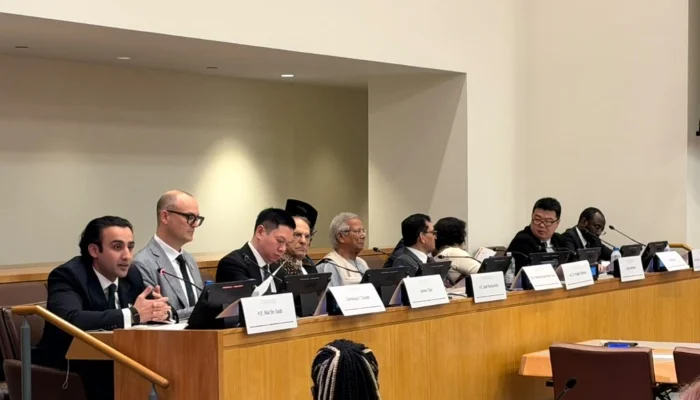
UNITED NATIONS: Pakistan Virtual Assets Regulatory Authority (PVARA) Chairman Bilal Bin Saqib has said artificial intelligence and tokenisation could become powerful tools for financial inclusion in the developing world.
Speaking at the Social Business, Youth and Technology Forum during the 81st Session of the United Nations General Assembly, Saqib called for wider access to emerging technologies for people excluded from traditional financial systems.
He said emerging economies now face important choices as global financial systems continue to evolve.
Around 1.3 billion adults worldwide remain without an account at a financial institution. However, nearly 900 million of them already own mobile phones.
Saqib said the gap was no longer simply about access to technology. He pointed to financial infrastructure, regulation and the willingness to build systems that can connect excluded communities.
Pakistan’s Virtual Asset Regulatory Framework
The forum brought together several prominent leaders and experts.
The opening panel included Dr Khalilur Rahman, President of the 81st UN General Assembly; Timor-Leste President and Nobel Peace Laureate José Ramos-Horta; Bhutan Prime Minister Dasho Tshering Tobgay; Brazil’s Minister Wellington Dias; and Nobel Peace Laureate Professor Muhammad Yunus.
The forum was also convened to honour Yunus for his pioneering work in microcredit.
Saqib presented Pakistan’s experience with virtual assets as an example of how developing countries can shape their own financial technology systems.
Pakistan closed its banking system to digital assets in 2018. The country later reopened the sector under the Virtual Assets Act 2026.
The legislation was followed by the establishment of a regulatory sandbox and licensing regulations for virtual asset service providers.
Independent global adoption indices estimate that more than 40 million people in Pakistan use virtual assets. This makes the country one of the largest and youngest virtual asset markets globally.
‘We Want to Be Makers’
Saqib said developing countries should not remain passive users of emerging technologies.
“For too long, the Global South has been on the menu. Pakistan has chosen the table, with our own pen, writing our own destiny,” he said.
He added that Pakistan wanted to help develop emerging technologies rather than simply adopt them.
“We do not want to be takers of this technology. We want to be makers of it,” Saqib said.
He stressed that technology and regulation must work together to achieve meaningful financial inclusion.
“Technology alone includes no one. Regulation alone includes no one. Inclusion happens where the two meet,” he said.
Focus on Young Innovators
Saqib also called on young innovators across the developing world to build new solutions without waiting for traditional systems to change.
He said emerging technologies could help countries pursue ambitious goals such as reducing poverty and unemployment.
The keynote ended with a call for the younger generation to use today’s technological tools to develop practical solutions for communities that remain excluded from traditional financial systems.