



Urdu Books Explore Language, Society and Muslim Baby-Naming
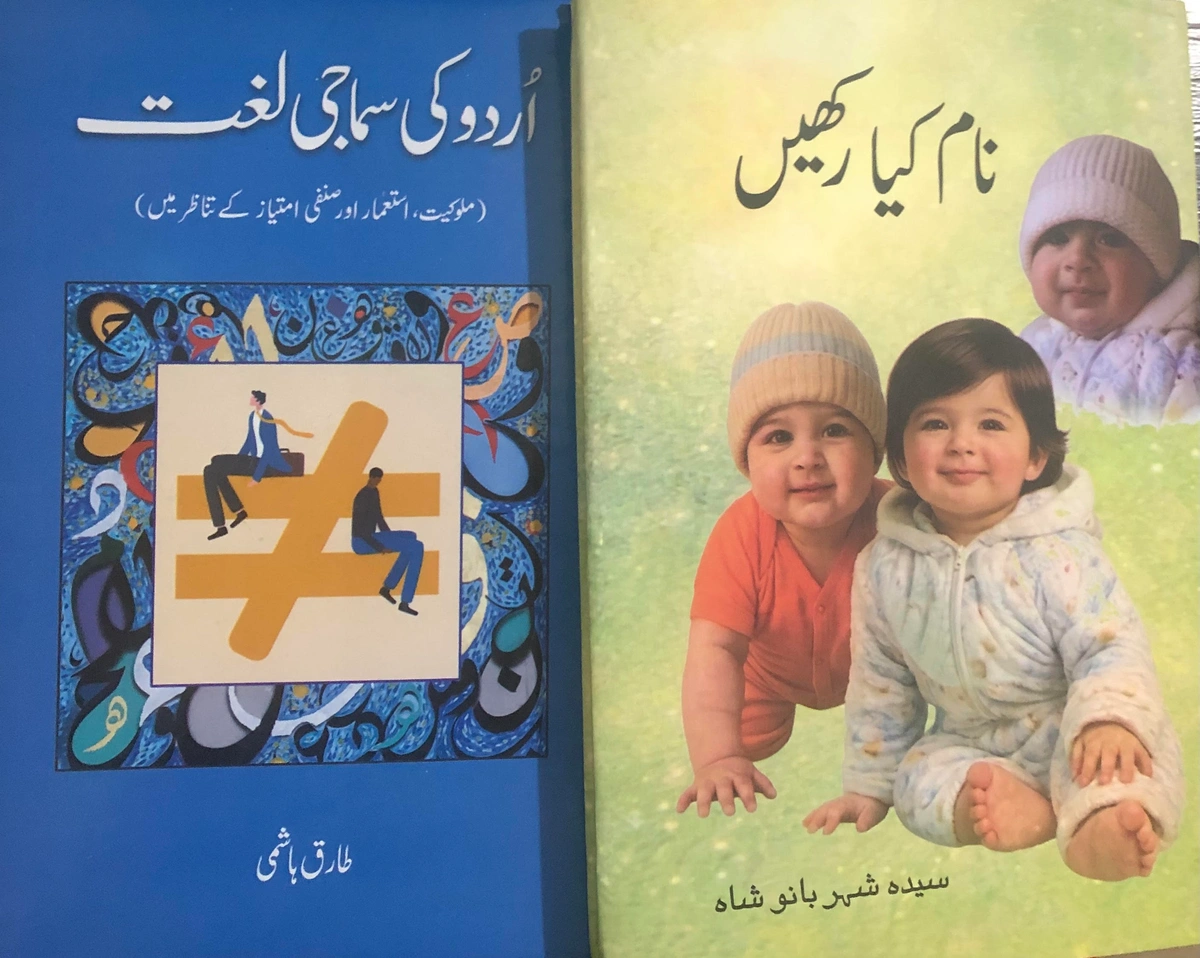
Two Urdu publications, Tariq Hashmi’s “Urdu ki Samaji Lughat” and Syeda Shaher Bano Shah’s “Naam Kya Rakhen,” explore language in society and the tradition of Muslim baby-naming.
The two books appeared from Karachi and Abbottabad in 2023 and 2026, respectively. The first examines Urdu words, idioms, proverbs, phrases, adages and maxims. It considers them in the context of changes linked to imperialism, colonialism and gender differentiation.
The second book focuses on baby-naming. It explains the subject in simple and intelligible language.
‘Urdu ki Samaji Lughat’
Title: Urdu ki Samaji Lughat
Author: Tariq Hashmi
Co-researcher: Khurram Shahzad Khurram
Theme: Malukiyat, Istemar aur Sinfi Imtiaz kay tanazur may
The book does not follow a customary catalogue. Instead, it uses a triangular categorisation.
First, the author provides an erudite foreword. Next, he presents an alphabetical description and evaluation of almost all conceivable denotive words, idioms, proverbs, phrases, adages and maxims in current Urdu. The book also includes a detailed bibliography.
The author dedicates the book, with a tinge of irony, to the upstarts sliding to regression.
He observes that people commonly believe a language derives its force, fluidity and felicity from the words its users employ in a particular societal speech pattern. Maxims and idioms, meanwhile, represent centuries-old folk wisdom.
In the author’s opinion, long-drawn autocratic despotism across the globe produced several adverse notions. These included class distinction, racism, gender discrimination and the demeaning of manual labour and skills.
The industrial revolution further aggravated these conditions. In less developed regions, the neo-colonial narrative gained its exploitative potential through the wilful manipulation of linguistic formations and transmutations.
The author says the book brings this linguistic repertoire into focus. In common parlance, people describe it as the ruler’s narrative that gradually evolves into a magnum common narrative.
The book arranges words, phrases, idioms and maxims in neat alphabetical order. It provides their meanings and detailed explanations where necessary.
As an interesting research study, the book adds valuable information to readers’ knowledge and consciousness. It can appeal to both casual and focused readers.
‘Naam Kya Rakhen’
Title: Naam Kya Rakhen
Author: Syeda Shaher Bano Shah
First edition: 1975
Second edition: 2026
Naam Kya Rakhen offers an interesting and informative publication on an important domestic subject. It focuses on naming children within our socio-cultural milieu.
The current work represents the second edition of the original book, which appeared in 1975.
The author is a celebrated teacher of English. She also comes from a respectable family of litterateurs and the cultural elite.
Baby-naming remains an important popular ritual in our traditional social setup. The book aims to facilitate Muslim households in this often tedious exercise.
The author lists an expansive variety of names. This range enables beneficiaries to select names according to their choice and liking for their children.
In his prefatory remarks, eminent writer and scholar late Ashfaq Ahmad commended the book’s contents. He called them a valued specimen of the author’s creative and critical insights.
At the same time, he hoped the book would open new avenues for connoisseurs of the art of baby-naming.
Late Bano Qudsia, another literary stalwart, also appreciated the author’s work. She praised her emphasis on the significance of a name and its connection with a child’s personality, psyche, character and behaviour.
She further observed that selecting a name, along with its concurrent psycho-moral eudaemonia, could play a vital role in the doing or undoing of a child.
At the end, the author discusses the accord between names and dates of birth. She also examines the digital value of a name and its bearing on the subject’s date of birth.
Her notes also discuss the suitability of a colour within the purview of a child’s date of birth.
The book therefore offers valuable content and provides worthwhile reading for those interested in the subject.