



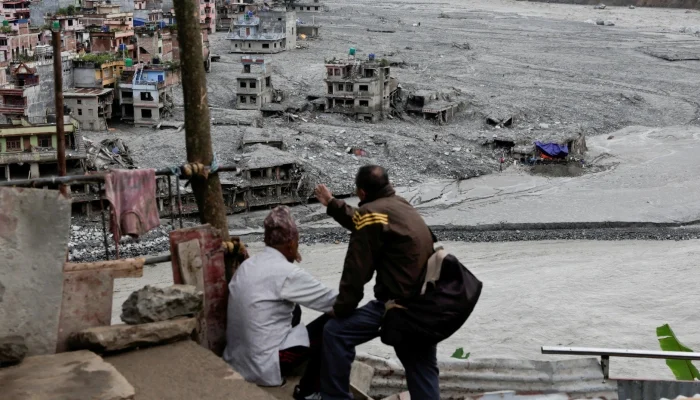
On the morning of August 26, the sky above Rasuwa in northern Nepal was clear. There was no rain and no warning.
High above the Nepal-China border, a mass of ice and rock broke away and fell into the Lhende Khola. The debris blocked the river for a few minutes before the blockage gave way.
The resulting surge registered on seismometers around the world as a magnitude 5.2 event. The US Geological Survey later confirmed that the tremor felt in the valley was not an earthquake. The collapse itself caused it.
A Wall of Water Crossed the Valley
The disaster unfolded within minutes. Scientists estimate that the wave covered the first 22 kilometres at an average speed of around 193 kilometres per hour.
The Trishuli rose by as much as nine metres in just 30 minutes. That is nine metres, not nine centimetres, in roughly the time it takes to drink a cup of tea.
At the time of writing, Nepal’s National Disaster Risk Reduction and Management Authority had confirmed 1,114 deaths. Roughly 4,500 people remained missing on both sides of the border, while nearly 12,000 had been rescued.
Both figures will likely change as rescue teams continue their work.
The disaster has already become Nepal’s deadliest since the 2015 earthquake. It destroyed 32 bridges and around 40 kilometres of road. Hydropower plants also suffered damage, along with the Rasuwagadhi border crossing that connects Kathmandu with Tibet.
Nepal’s Warning System Could Not Keep Up
Nepal did have monitoring equipment in the region.
A monitoring station near the border transmitted river data every ten minutes. It continued operating normally until 8:40am.
The 8:50am reading never arrived. By then, the flood had destroyed the station.
The Department of Hydrology and Meteorology received the first information about the disaster roughly 16 minutes after the water had already entered Nepal.
Officials then sent text alerts to nearby communities. However, the flood had already passed through many of those areas.
The warning system worked as designed. The problem was that the system expected a monsoon river to rise gradually. It was not designed for a mountain to suddenly collapse into a river on a dry morning.
That is not simply a Nepali failure. It is a South Asian warning, and Pakistan should take notice.
A Disaster Without Borders
The water did not stop at Nepal’s border.
The Trishuli joins the Narayani before the river enters India as the Gandak. Within a day, Indian authorities began evacuating people from low-lying areas of Bihar, Uttar Pradesh and Uttarakhand.
Bihar also opened all 36 gates of the Gandak barrage at Valmikinagar. Authorities later recovered bodies around 240 kilometres downstream inside India.
A glacier failed on the Tibetan frontier, yet farmers in Bihar had to leave their homes.
What happened in Nepal did not stay in Nepal. Similar disasters will never respect national borders.
Pakistan Faces a Similar Threat
The Hindu Kush Himalaya acts as a water tower for nearly two billion people. However, its glaciers lost ice around 65 per cent faster between 2011 and 2020 than during the previous decade.
As glaciers retreat, mountain slopes can become unstable. Thawing permafrost can further weaken the mountainsides. Meltwater can also collect in locations that authorities have not mapped.
The danger crosses borders. Our disaster response, however, remains largely national.
Pakistan has more glaciers than any country outside the polar regions. More than 3,000 glacial lakes also sit across Gilgit-Baltistan and Khyber Pakhtunkhwa.
The UNDP classifies 33 of these lakes as hazardous. Around seven million people live below them.
In 2025, glacial lake outburst floods killed dozens in Gilgit-Baltistan. The floods also cut off valleys such as Diamer and Ghizer.
The geography of Rasuwa looks familiar to Pakistan. A narrow valley follows the river. Roads run along the riverbed because little space exists elsewhere. Villages also sit below water bodies that did not exist when their grandparents settled there.
Climate Displacement Is Already Happening
At the other end of Pakistan, rising water is becoming a permanent threat.
I have stood at Keti Bundar and looked across the open sea towards where the village once stood. This is not a projection in a report. Vast areas of Thatta, Sujawal and Badin have already lost land to saltwater.
Families now receive drinking water by drum. Fishing grounds have collapsed, while the mangroves that once absorbed storm surges have thinned.
I met families who had already moved twice. I also met fishermen who now work on other people’s boats because they lost their own.
Ask where these families go, and the answer is often Karachi.
Displaced Families Become Invisible
Many displaced families end up in katchi abadis around Karachi. They work as labourers and domestic staff in settlements without secure tenure or basic services.
Yet nobody properly counts them.
Official statistics have no clear category for people displaced by seawater intrusion. Provincial budgets also have no dedicated line for them.
As a result, the state quietly absorbs them into the urban poor. Their reason for becoming poor then disappears from the record.
If we cannot count these families, we cannot plan for them. We will continue treating their suffering as bad luck instead of a policy failure.
Pakistan Faces Compound Displacement
In my research on climate displacement in India and Pakistan, I have called this “compound displacement”.
It does not involve one dramatic exodus. Instead, families move repeatedly until temporary displacement becomes permanent insecurity.
A household moves after a flood. It later returns and rebuilds with borrowed money. The next crop then fails because of salinity.
After the third move, the family may have no assets, documents or realistic way home.
In 2022, around eight million Pakistanis were driven from their homes. The 2025 monsoon floods killed more than 1,000 people, affected close to seven million and forced around three million to flee.
Those figures can hide an important reality. Many of these disasters affect the same families again and again.
Displacement Affects Every Part of Life
Displacement never travels alone.
It affects health as displaced people face waterborne diseases and untreated illnesses. It affects education when girls leave school and struggle to return.
The problem also reaches Pakistan’s cities. Families arriving on the outskirts of Karachi and Lahore often find no housing policy waiting for them. Instead, they may end up living in another flood-prone area.
The atmosphere itself is not the crisis. The real crisis lies in what a changing climate does to societies that already face deep vulnerabilities.
Pakistan Needs a Legal Framework
Pakistan also lacks a clear legal framework for people displaced within the country by disasters.
There is no specific law on internal displacement. People displaced by disasters also lack a protected legal status and a comprehensive resettlement framework.
Climate policy documents frequently use the word “resilience”. Yet they provide few enforceable rights for displaced families.
That gap leaves vulnerable people dependent on temporary relief instead of long-term protection.
The Same Warning Keeps Returning
We all know the pattern.
Something breaks. Images of the destruction dominate the news. Governments pledge money, while television programmes focus on the disaster for a few weeks.
Then the water recedes. The cameras leave. The file closes until the next disaster.
Nepal knows this cycle too.
The same river flooded in July 2025 and destroyed the Nepal-China Friendship Bridge at the same crossing. The warning gap identified at that time still existed on August 26.
Pakistan faces a similar problem. We commission reports after floods but often implement only the cheapest recommendations.
What Serious Climate Planning Would Look Like
So, what would serious action actually require?
First, Pakistan needs hazard maps and reliable monitoring for every dangerous glacial lake above an inhabited valley. Authorities cannot limit these efforts to a handful of pilot projects.
Second, the country needs early-warning systems designed for sudden disasters. Sensors must survive the very events they exist to detect.
Alerts must also reach people directly. A shepherd in Ghizer should receive a warning on their phone rather than leaving the information inside a control room in Islamabad.
Third, authorities need stronger land-use rules. A riverbed remains a riverbed even when it looks dry. Officials must enforce those rules against people who build in dangerous areas.
Pakistan also needs a national register of displaced people. Families leaving the delta should no longer remain invisible.
Finally, the country needs a legal framework that gives displaced families a clear status and entitlement. A family forced from Keti Bundar or Ghizer should receive more than a temporary tent.
Pakistan Cannot Afford to Wait
None of these measures would cost as much as a major disaster.
Nepal has delivered a warning that has already cost more than a thousand lives. Pakistan has received that warning for free.
The only question is whether we act before our own August 26 or wait until after it.