



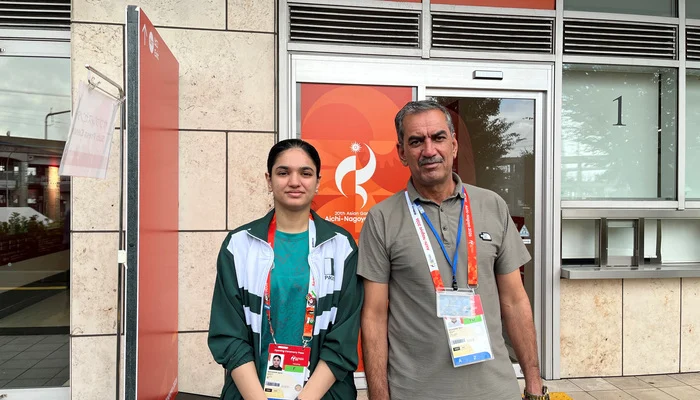
NAGOYA: Inside a squash court, 20-year-old Pakistani player Sana Bahadar communicates through her racquet.
Outside the glass walls, she relies on sign language and lip reading.
Deaf and non-verbal since birth, Sana grew up facing communication challenges. Her two younger brothers also have the same condition.
Squash has since given her a powerful way to express herself and build confidence.
Her Asian Games debut ended in the round of 32 after she lost to Iran’s Najmeh Boushehrizadeh. However, simply competing at the Aichi-Nagoya Games marked a major achievement for the young athlete.
“She’s a role model not just for kids who can’t hear or speak,” her father, Sher Bahadar, told Reuters at the Kinjo Futo Arena.
“In our family circles, she’s seen as an example of where talent and commitment can take you.”
Family Makes Major Sacrifices
Sana’s journey has required significant financial sacrifices from her family.
Her father runs a printing business in Peshawar. This year, he sold two printing machines to help finance Sana’s overseas trips.
The demands of accompanying her abroad have also affected his business. He said the business has declined by around 60%.
Despite the financial pressure, Bahadar said he has no regrets.
“I have no regrets, though. Because of her, I get to travel and meet so many great athletes. We are absolutely proud of her,” he said.
Sana started playing squash at the age of 10. She was later introduced to Pakistani squash great Qamar Zaman, who took her under his guidance.
Bahadar said he wanted his daughter to have opportunities beyond the traditional vocational training offered at special schools.
“You know how it is in those special schools. They herd students into stitching, weaving and carpentry classes. I said, why not IT or sports?” he said.
Financial Challenges Continue
Sana’s progress soon brought further financial challenges after she became Pakistan’s national champion.
A Karachi-based foundation provides around Rs4 million annually to support her career. However, Bahadar said the amount does not cover the costs of overseas training.
Sana needs regular training opportunities in countries including China and Malaysia to continue developing as an international player.
“There’s a limit to government help and somehow, private sponsorship has not really been forthcoming,” Bahadar said.
“Maybe because she can’t speak, they can’t use her in TV commercials, or some other reasons.”
Despite those difficulties, Sana’s progress has transformed her life and changed how her family sees her future.
“It has totally transformed not just her but the entire family. She and her mother used to cry a lot. She had an identity crisis,” Bahadar said.
“Now look at her, full of confidence and going places we never thought she would.”
Sana responded with a warm smile as her father spoke about her journey.
Target Set for World Top 100
Sana currently sits at No. 179 in the world rankings after winning the Bendigo Open in Australia last month.
Her next major goal is to break into the world’s top 100 next year.
Bahadar believes she can go even further if she gets the right training support.
“She can do way better,” he said.
The family also hopes Sana can reunite with her former coach, who has moved to China, and train there.
However, that plan depends largely on whether they can secure enough funding.
For Sana, the journey from communication difficulties to the international squash stage has already changed her life. Her family now hopes the next chapter will take her into the world’s top 100.