



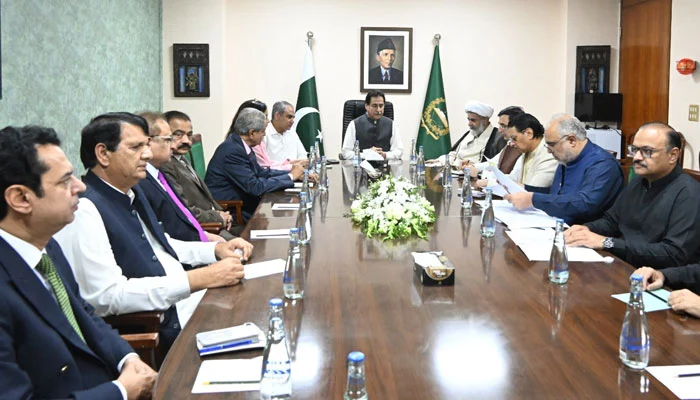
ISLAMABAD: Government-opposition negotiations aimed at averting the Pakistan Tehreek-e-Insaf’s (PTI) October 4 long march on Islamabad collapsed around 3am on Sunday.
Four rounds of drafting failed to bridge differences over counterterrorism cooperation in Khyber Pakhtunkhwa (KP) and access to jailed PTI founder Imran Khan.
Both sides blamed the other for the breakdown. Here is what key participants said:
Interior Minister Mohsin Naqvi
Interior Minister Mohsin Naqvi said an agreement had been prepared after the negotiations.
He said he took a copy of the draft to President Asif Ali Zardari. However, upon returning, he learned that KP Chief Minister Sohail Afridi had made several changes to the document.
“Unfortunately, the KP chief minister tried to sabotage the negotiations,” Naqvi said.
According to the minister, 99% of the issues had been settled and four drafts had been prepared and amended.
Naqvi said the KP government had agreed to several commitments. These included condemning the Tehreek-e-Taliban Pakistan (TTP) and other militant groups, supporting the national policy on Afghan refugees and having no contact with the Afghan Taliban regime.
He said the provincial government had also agreed to provide substantial funding for counterterrorism and police operations, take ownership of counterterrorism measures and strengthen cooperation with the armed forces.
“Last night, during the final phase of negotiations, the KP government backed out of these commitments,” Naqvi said.
He placed responsibility for the talks’ failure on Afridi and warned that the chief minister would be responsible if anyone lost their life during the long march.
Naqvi added that the president and prime minister would make the final decision on the government’s next course of action.
PPP’s Sherry Rehman
Pakistan Peoples Party (PPP) leader Sherry Rehman also blamed the KP government for the breakdown.
She said four drafts had been agreed upon with the principals of the negotiating teams before the PTI reopened the discussions.
“Sorry to say, despite four drafts that we had closed with all our principals and then again reopened to accommodate PTI’s changes, talks collapsed on the KP government’s unilateral refusal to sign the afternoon’s pre-agreed draft on counterterrorism cooperation with the Centre,” she said.
Rehman said the PPP-government team had repeatedly asked for KP government representatives to participate alongside the PTI’s senior leadership.
She claimed that neither the chief minister nor cabinet representatives joined the negotiations.
She also criticised the PTI for presenting new drafts on social media instead of communicating through a provincial negotiating committee.
“I have never in my 25 years in parliament seen such a reckless squandering of an opening to begin political confidence-building measures, and to bring stability to Pakistan after years of bitter political division,” Rehman said.
PTI’s Salman Akram Raja
PTI Secretary General Salman Akram Raja gave a different account of the failed negotiations.
He said the main disagreement concerned the federal government’s demand that KP take ownership of counterterrorism actions that had been initiated unilaterally.
Raja said the PTI-TTAP negotiating team wanted future counterterrorism measures to be based on an agreement between the federal and provincial governments.
He said such a framework should involve consultation with all political parties represented in the KP Assembly.
“The PTI-TTAP team was clear that we have zero tolerance for terrorism and are committed to rooting it out,” Raja said.
He added that the party opposed “collateral damage” involving innocent civilians and the displacement of local residents.
Raja said the federal government had rejected the recommendations of a KP Assembly jirga involving political and tribal leaders, including representatives from the merged districts.
PTI’s Asad Qaiser
PTI leader Asad Qaiser said his party had consistently made national interests its priority.
He said KP had faced instability and terrorism for almost four decades, affecting peace, businesses, investment and ordinary citizens.
Qaiser said the KP Assembly’s unanimous resolution should be considered when developing future counterterrorism policy.
He also called for consultations with all political parties and stakeholders in the province.
He said the federal government should consult parties including Jamaat-e-Islami (JI), Awami National Party (ANP), PPP and PML-N even if it did not want to engage directly with the PTI.
Qaiser said access to Imran Khan was another major point of disagreement.
“The deadlock came because we wanted access to Imran Khan first. We withdrew all other demands — our only demand was that our political leadership be given access to Imran Khan,” he said.
According to Qaiser, the government refused to include access to Khan in the agreement.
He argued that PTI should have the same right to consult its leader as other political parties consult their leadership.
Qaiser said the PTI had proposed continuous and meaningful federal-provincial consultation to eliminate terrorism in KP.
Under the proposal, federal and provincial representatives would meet within 72 hours to prepare a jointly agreed action plan involving political parties and other stakeholders.
Opposition Seeks Access to Imran Khan
Senate Opposition Leader Allama Raja Nasir Abbas said differences also remained over a meeting with Imran Khan and access to his personal doctor.
He said the government had stated that it was not currently in a position to arrange a meeting with Khan.
However, meetings between Khan’s sisters and lawyers would reportedly be allowed to begin.
Abbas said the opposition had also sought clarity over military operations in areas hosting internally displaced persons.
PTI Says Long March Will Continue
PTI Chairman Barrister Gohar Khan said the long march would proceed despite the failure of negotiations.
He said the party wanted the talks to succeed but stressed that political developments could still change.
“We wanted the negotiations to succeed,” Gohar said.
He also called for restraint during the protest and warned against measures that could create tensions in KP.
Gohar said the long march should not be met with emergency rule or governor’s rule.
Government Warns Against Entry Into Islamabad
Prime Minister’s Adviser Rana Sanaullah said the KP government must fulfil its constitutional responsibility regarding terrorism.
He said the provincial government had failed to provide adequate assurances about its role in counterterrorism efforts.
“The long march will not be allowed to enter Islamabad’s limits, and any form of unrest will be dealt with through the force of law,” Sanaullah said.
He added that no date had been fixed for another round of negotiations.