



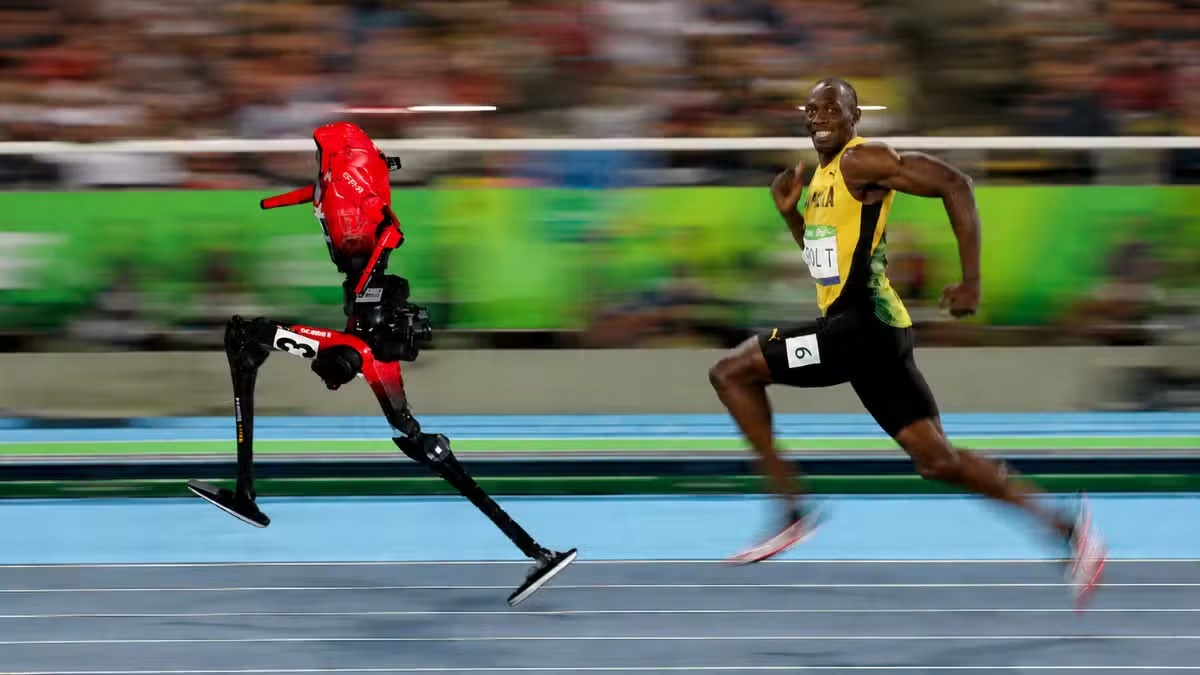
A Chinese humanoid robot has stunned spectators by running 100 metres faster than Usain Bolt’s legendary world record at the World Humanoid Robot Games in Beijing.
The robot, Tiangong Ultra, completed a 100-metre preliminary heat in just 9.39 seconds. The time was faster than Bolt’s men’s world record of 9.58 seconds, set at the 2009 World Championships in Berlin. Another humanoid robot, Lightning, also finished the race in under Bolt’s record time, clocking 9.47 seconds.
Tiangong Ultra Runs 100 Metres in 9.39 Seconds
Tiangong Ultra was developed by the Beijing Humanoid Robot Innovation Center. The robot initially trailed Lightning during the race but accelerated near the finish to take first place in its heat.
Its 9.39-second performance represents a major improvement in humanoid robot speed. Tiangong Ultra had recorded a much slower time of 21.50 seconds in the 100-metre event at the previous edition of the competition.
Lightning, developed by Chinese smartphone maker Honor, also impressed during the event. Earlier preparatory tests reportedly saw Lightning complete the 100 metres in 9.32 seconds, although its official race performance at the games was reported at 9.47 seconds.
More Than 2,000 Robots Compete in Beijing
The second World Humanoid Robot Games has brought together 2,056 robots from 666 teams representing 16 countries. The five-day event features 51 competitions, including 30 sports events and 21 challenges designed to test robots in practical and real-world scenarios.
The competition includes events such as sprinting, football, table tennis, martial arts and other activities that test speed, balance, coordination and autonomous decision-making.
More than 40 percent of the competitions require robots to operate autonomously, making the event about more than simply demonstrating athletic speed.
Robots Still Face Major Challenges
Despite their record-breaking speed, the humanoid robots also showed that major technical challenges remain.
Reports from the event said Tiangong Ultra struggled to stop after crossing the finish line, while Lightning collapsed after its run. The incidents highlighted the difficulty of maintaining stability and control at extremely high speeds.
Experts believe that while robots are making rapid progress in movement and physical performance, real-world tasks requiring precise coordination and adaptability remain a bigger challenge.
Activities such as connecting cables, handling objects and navigating unpredictable environments require a different level of intelligence and control.
China Pushes Ahead in Humanoid Robotics
China has made humanoid robotics a major technology priority and continues to invest heavily in artificial intelligence, robotics hardware and automation.
The World Humanoid Robot Games are designed to showcase advances that could eventually help robots perform tasks in industries such as manufacturing, logistics, emergency response and other everyday environments.
While Tiangong Ultra’s performance does not mean robots are replacing human athletes, its 9.39-second sprint shows just how quickly humanoid robotics is advancing.
For now, the race marks another major milestone for robotics, demonstrating that machines can already surpass some human athletic records while still facing significant challenges in balance, precision and real-world autonomy.